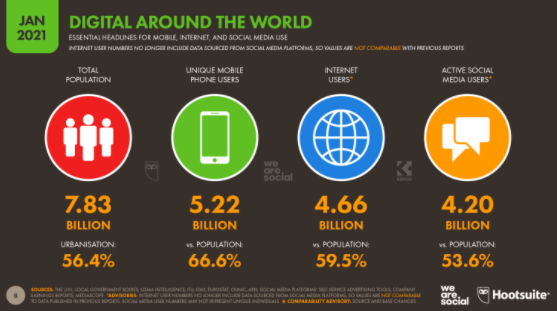



The world’s population stood at 7.83 billion at the start of 2021. The United Nations reports that this figure is currently growing by 1 percent per year, which means that the global total has increased by more than 80 million people since the start of 2020.
5.22 billion people use a mobile phone today, equating to 66.6 percent of the world’s total population. Unique mobile users have grown by 1.8 percent (93 million) since January 2020, while the total number of mobile connections has increased by 72 million (0.9 percent) to reach a total of 8.02 billion at the start of 2021.
4.66 billion people around the world use the internet in January 2021, up by 316 million (7.3 percent) since this time last year. Global internet penetration now stands at 59.5 percent.
There are now 4.20 billion social media users around the world. This figure has grown by 490 million over the past 12 months, delivering year-on-year growth of more than 13 percent. The number of social media users is now equivalent to more than 53 percent of the world’s total population.
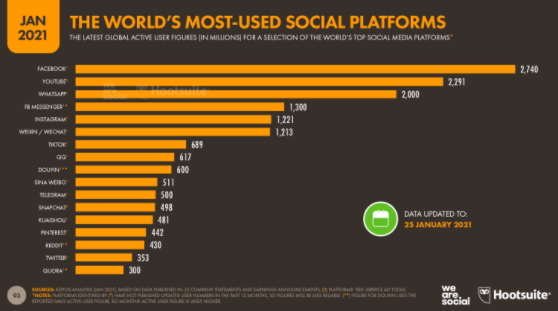
98 percent of the users of any given social media platform use at least one other social platform
The audiences of individual social platforms are also subject to significant overlaps
85 percent of TikTok users aged 16 to 64 also use Facebook
95 percent of Instagram users also use YouTube
When you are planning a marketing using social media, consider the following:
Target audience who do I want to engage?
Why are they using social media?
Which social media channels might that target audience be on?
How can I reach and engage them?
What types of content are they engaging with?
Data supplied by Hootsuite
If you need any advice on the use of social media, campaigns, advertising, setting up accounts and pages, training or need to outsource your social media to an expert, and we are here to assist in that area.
For more advice view here or contact us

Read our guide to B2B content Marketing to learn the Tactics You Need to Know to Get It Right the First Time

B2B doesn’t have to mean boring. All too often, B2B content marketing is assumed to be dull, boring, and massively uninteresting when compared with B2C.
But scratch that – For many B2B brands, content marketing provides the backbone of their customer acquisition strategy. When a solid strategy in place, it can be a phenomenal growth engine.
At Focus Ecommerce and Marketing, we will show you everything you need to know about driving growth for your business with content marketing.

B2B content marketing acts as a critical elemental tool that leverages content as the core strategy to engage with prospects and customers.
The content surges typically in digital formats such as blogs, videos, articles, buyers’ guides, white papers, research reports or even social media posts, which is intelligently framed so as to entice its target audience with purposeful, focused content around topics of their interest.
Since the B2B purchase cycle is more complex than the B2C purchase cycle, buyers in B2B buying panel tend to do more research around the company, its products, its reputation, certifications and more. That’s why B2B marketers try to provide informative, non-promotional content that helps buyers make informed choices.
B2B marketing campaigns are aimed at individuals with control or influence on purchasing decisions. Hence the content is also customised to provide relevant data and facts to the individual.
The content-focus of B2B content marketing is to make sure that it is useful and practical for other companies. B2B content marketing has to be engaging and compelling over a sustained period, ensuring it can keep pace with the evolution of the buyers’ journey and beyond.
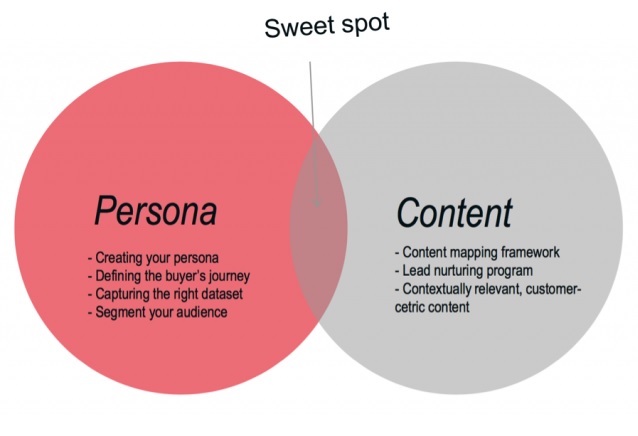
It is important to have an in-depth understanding and analysis of your target audience before you kickstart your content creation that will entice and attract prospects.
Segment the audience as per the stage of the buyer’s funnel. This is where the reader personas become significant. You have to identify potential buyers from the people that are visiting your website. By the use of Google Analytics, you can find out their necessary demographic details, such as name, age, gender, location, as well as recurring themes of interest.
Regularly coming up with new content ideas can often be one of the most significant challenges for content marketers. Here is a crucial insight which you can implement in your overall content marketing plan.
Create content which will always be useful to your B2B audiences. Typically, content itself should be elaborative; it should cover the entire gamut of the topic so that your readers can stay on your content page to get all the relevant information.
Now there are many ways in which you can position your content to rank high on Google and generate traffic to your website. Such as leveraging social media insights, testing topical themes with content snippets on social media and finding topic popularity trends with Google Trends.
If you would like to find out more about content marketing, how we can help your business attract and maintain new customers, contact Sue Moscatelli or Ivan Latter at Focus E-Commerce & Marketing. Sue has over 25 years of experience in B2C and B2B marketing from branding, positioning, tone of voice, positioning through to promotional activity, POS, sales support tools, events and sponsorships.

Content marketing, clearly described, is the process of producing original, high-quality content targeted at a specific audience, attracting their interests and addressing their points of pain. Creating a content strategy means instead of making a hard sell, by offering useful information that earns goodwill and interaction, it usually promotes a brand, service, or product.

The primary objective of this initiative is to convert consumers to buyers, directing them through the process of meeting their needs in the sales funnel, to prove yourself to be a credible source of knowledge, to position yourself as the best placed authority to assist them, and then to convert interest to paid business and a valuable ongoing connection.
The advantages of a well-executed eCommerce content strategy include:
When your creating a content strategy you need to know who your buyer is in order to create e-commerce website content targeted to consumer needs. You can create content targeted at them by creating a character or fictionalized image of a customer or buyers based on real data and
marketing insights, refining it depending on what part of the sales funnel you position it and which part of the purchaser’s journey you are targeting.
For instance, without any sales message, you will provide content customized to their needs at the top of the sales funnel. Further down the funnel, once you’ve won their confidence, you might start providing potential solutions to customer problems and have a more tailored sales pitch to convert them to paying business.
The things you will want to know for your buyer persona include:
You should find out how your audience wants to consume content to target them the same way for your e-commerce website content by looking at your internal data or researching market trends.
Some questions you’ll want to answer include:

For creating a content strategy you need to do some research at the front end to build an efficient content strategy for e-commerce. For instance,
The sales or marketing funnel is divided into three parts a top, middle, and bottom that corresponds to various parts of the purchaser’s path.

The top of the funnel is the process of customer exploration or understanding, where you prove that you know their points of pain. Your content is easily found and consumed at this stage.
The content offers solutions to issues without any particular sale of your product or service, whether by blogging, social media marketing, search engine marketing, or any other medium.
The middle section of the Sales & Marketing funnel is the step of evaluation, where you engage with your prospective clients more profoundly, building confidence. You have proven that you know their points of discomfort, and now you can start pointing to solutions that will assist them. Where you tried to educate customers before, you are now leading them to the right responses.
Here, the items you offer might include comparison guides, case studies, and even free samples. Consumers usually do extensive research on the subject at this point, including whether your approach is the right match for them.
The bottom of the sales funnel is the purchase stage, where people put their money where their interest is. Here is where you prove that your outstanding value is just too much to be passed by. At this purchase stage, you might use live chat, a chatbot, or emails to customers at the point of buying or retargeting/remarketing to keep your message in front of someone at the tipping point.
The Decision stage, where people put their money where their interest is. Here is where you prove that your offer is just too good to miss out on. At this decision stage, at the point of purchase or retargeting/remarketing, you might use live chat, a chatbot, or emails to customers to hold your message in front of someone at the tipping point.
Since creating a content ctrategy on ecommerce websites is typically an ongoing operation, and not a one-off thing, you need to look at the results from past attempts to enhance those that are going forward.
Good metrics will inform you what sort of investment return (ROI) you have accomplished. Progress may be evaluated by such factors as:
Organic traffic, Leads, Conversion rate, Time on page, Social shares, Engagement, ROI, Backlinks
Bear in mind that the specific metrics you want to measure will vary depending on the content type. Some forms of content and the metrics on which you would want to base performance include:
Blog posts/articles: Key performance indicators (KPIs) range from website traffic and unique visitors to page views per visit and geographic trends.
Email: Indicators include open rate, conversion rate, and click-through rate.
Social media: Followers/fans, Likes, and post reach are among the KPIs.
Videos: These include unique viewers, shares, and average view duration.
Podcasts: Downloads, subscribers, and shares are included here.
Pay-per-click (PPC) campaigns: The many KPIs range from cost per click and click-through rates to cost per sale and impressions.
At Focus Ecommerce & Marketing we have the tools to help you measure the performance of your content activity. We can analyse various pieces of content and tailor that content to meet your specific needs.
Listening to what your clients have to say is a huge part of enhancing the content you deliver and making sales. Knowing what your customer feels about your sales process is vital for potential progress, whether you send a follow-up note, review live chat recordings, perform customer interviews, evaluate documented sales calls, track social media networks, or employ other means.
Some ways customer feedback can help your ecommerce content strategy include:
Ensure you have an effective customer support service: Customer feedback is one way to help gauge whether you have a sustainable customer support system, which ultimately can help keep sales coming in.
Qualitative feedback about content: Although we have suggested ways to get data, qualitative feedback is also very valuable. Through customer surveys, you can figure out whether your content is helpful to your customers. The more helpful your content, the more likely you will find more people who want to use your product or service.
Potential to use feedback as promotional content: Arguably, the biggest benefit to customer feedback is the possibility of using it to persuade new customers. Testimonials are a great way to add value to your brand and hopefully increase your bottom line.
When developing an ecommerce content strategy, there a variety of content types at your disposal. Focus Ecommerce & Marketing can assist you with any of the following:
Blogging: Blog posts are fundamental to the majority of content marketing strategies, building customer relationships, delivering leads, and lending themselves to search engine optimization (SEO) practices.
Original photography: In this digital age people are unable to touch what your goods, using photography helps to make up for this fact. Create a set of images for each product, tagging them correctly will help search engines understand what you are offering. Create lifestyle shots so people can imagine wearing or using the item.
Video content: Videos create an immersive experience and are proven to drive up the number and size of sales. Social media channels recommend the use of video as a way of increasing engagement.
Product guides: These can attract more traffic to your ecommerce website as people look for more information about products and services.
Customer stories: Customer testimonials, reviews, case studies and user generated content.
Email marketing: Even just confirming orders, notifying buyers about shipping and package delivery, and doing a follow-up gives you multiple chances to communicate with customers and build relationships.
The most effective ecommerce strategy combines all of these elements. All brands, large and small need to invest in content marketing because it is crucial to attracting new business and staying competitive.
We can provide a comprehensive, all-in-one solution to boost your online selling presence, whether it’s to get more traffic with organic and paid searches or create unique content that meets marketing and sales goals.
| Cookie | Duration | Description |
|---|---|---|
| apbct_cookies_test | never | CleanTalk sets this cookie to prevent spam on comments and forms and act as a complete anti-spam solution and firewall for the site. |
| apbct_headless | never | Cleantalk set this cookie to detect spam and improve the website's security. |
| apbct_page_hits | never | CleanTalk sets this cookie to prevent spam on comments and forms and act as a complete anti-spam solution and firewall for the site. |
| apbct_pixel_url | never | Clean Talk sets this cookie to make WordPress anti-spam cookies, e.g., spam on forms and comments. |
| apbct_site_landing_ts | never | CleanTalk sets this cookie to prevent spam on comments and forms and act as a complete anti-spam solution and firewall for the site. |
| apbct_timestamp | never | CleanTalk sets this cookie to prevent spam on comments and forms and act as a complete anti-spam solution and firewall for the site. |
| apbct_urls | never | CleanTalk Spam Protect sets this cookie to prevent spam on our comments and forms and acts as a complete anti-spam solution and firewall for this site. |
| apbct_visible_fields | never | CleanTalk sets this cookie to prevent spam on the site's comments/forms, and to act as a complete anti-spam solution and firewall for the site. |
| cookielawinfo-checbox-analytics | 11 months | This cookie is set by GDPR Cookie Consent plugin. The cookie is used to store the user consent for the cookies in the category "Analytics". |
| cookielawinfo-checbox-functional | 11 months | The cookie is set by GDPR cookie consent to record the user consent for the cookies in the category "Functional". |
| cookielawinfo-checbox-others | 11 months | This cookie is set by GDPR Cookie Consent plugin. The cookie is used to store the user consent for the cookies in the category "Other. |
| cookielawinfo-checkbox-advertisement | 1 year | Set by the GDPR Cookie Consent plugin, this cookie records the user consent for the cookies in the "Advertisement" category. |
| cookielawinfo-checkbox-necessary | 11 months | This cookie is set by GDPR Cookie Consent plugin. The cookies is used to store the user consent for the cookies in the category "Necessary". |
| cookielawinfo-checkbox-performance | 11 months | This cookie is set by GDPR Cookie Consent plugin. The cookie is used to store the user consent for the cookies in the category "Performance". |
| CookieLawInfoConsent | 1 year | CookieYes sets this cookie to record the default button state of the corresponding category and the status of CCPA. It works only in coordination with the primary cookie. |
| ct_has_scrolled | never | CleanTalk sets this cookie to store dynamic variables from the browser. |
| ct_pointer_data | never | CleanTalk sets this cookie to prevent spam on the site's comments/forms, and to act as a complete anti-spam solution and firewall for the site. |
| ct_timezone | never | CleanTalk–Used to prevent spam on our comments and forms and acts as a complete anti-spam solution and firewall for this site. |
| elementor | never | The website's WordPress theme uses this cookie. It allows the website owner to implement or change the website's content in real-time. |
| OptanonConsent | 1 year | OneTrust sets this cookie to store details about the site's cookie category and check whether visitors have given or withdrawn consent from the use of each category. |
| viewed_cookie_policy | 11 months | The cookie is set by the GDPR Cookie Consent plugin and is used to store whether or not user has consented to the use of cookies. It does not store any personal data. |
| _GRECAPTCHA | 6 months | Google Recaptcha service sets this cookie to identify bots to protect the website against malicious spam attacks. |
| _lfa | 1 year | This cookie is set by the provider Leadfeeder to identify the IP address of devices visiting the website, in order to retarget multiple users routing from the same IP address. |
| __cfruid | session | Cloudflare sets this cookie to identify trusted web traffic. |
| __cf_bm | 1 hour | This cookie, set by Cloudflare, is used to support Cloudflare Bot Management. |
| Cookie | Duration | Description |
|---|---|---|
| ct_checked_emails | never | Clean Talk sets this cookie to prevent spam on the site's comments or forms. |
| ct_checkjs | never | Clean Talk sets this cookie to prevent spam on the site's comments or forms. |
| ct_fkp_timestamp | never | Clean Talk sets this cookie to prevent spam on the site's comments or forms. |
| ct_ps_timestamp | never | Clean Talk sets this cookie to prevent spam on the site's comments or forms. |
| Cookie | Duration | Description |
|---|---|---|
| wow.schedule | 20 minutes | This cookie is set by the provider Communigator.This cookie is used to track the Load Balance Session Queue. |
| _calendly_session | 21 days | Calendly, a Meeting Schedulers, sets this cookie to allow the meeting scheduler to function within the website and to add events into the visitor’s calendar. |
| Cookie | Duration | Description |
|---|---|---|
| ct_screen_info | never | CleanTalk sets this cookie to complete an anti-spam solution and firewall for the website, preventing spam from appearing in comments and forms. |
| wow.anonymousId | 1 year 1 month 4 days | This is a analytic cookie used to store anonymous visitor ID. It tracks the visitor uniquely between visits. |
| wow.session | 20 minutes | This cookie is set by the provider Communigator.This cookie is used to track the Internet Information Services(IIS) session state. |
| wow.utmvalues | 20 minutes | This cookie is from Communigator. This cookie is used to store UTM values for the session.UTM values are specific text strings that are appended to URLs that allow Communigator to track the URLs and the UTM values when they get clicked on |
| _fbp | 3 months | Facebook sets this cookie to display advertisements when either on Facebook or on a digital platform powered by Facebook advertising after visiting the website. |
| _ga | 1 year 1 month 4 days | Google Analytics sets this cookie to calculate visitor, session and campaign data and track site usage for the site's analytics report. The cookie stores information anonymously and assigns a randomly generated number to recognise unique visitors. |
| _ga_* | 1 year 1 month 4 days | Google Analytics sets this cookie to store and count page views. |
| _gcl_au | 3 months | Google Tag Manager sets the cookie to experiment advertisement efficiency of websites using their services. |
| __kla_id | 1 year 1 month 4 days | Klaviyo sets this cookie to collect information on the visitor’s behavior. This information is used for internal analytics and to optimise the website. It also registers if the visitor has subscribed to a news letter. |
| Cookie | Duration | Description |
|---|---|---|
| test_cookie | 15 minutes | doubleclick.net sets this cookie to determine if the user's browser supports cookies. |
| VISITOR_INFO1_LIVE | 6 months | YouTube sets this cookie to measure bandwidth, determining whether the user gets the new or old player interface. |
| VISITOR_PRIVACY_METADATA | 6 months | YouTube sets this cookie to store the user's cookie consent state for the current domain. |
| YSC | session | Youtube sets this cookie to track the views of embedded videos on Youtube pages. |
| yt-remote-connected-devices | never | YouTube sets this cookie to store the user's video preferences using embedded YouTube videos. |
| yt-remote-device-id | never | YouTube sets this cookie to store the user's video preferences using embedded YouTube videos. |
| yt.innertube::nextId | never | YouTube sets this cookie to register a unique ID to store data on what videos from YouTube the user has seen. |
| yt.innertube::requests | never | YouTube sets this cookie to register a unique ID to store data on what videos from YouTube the user has seen. |
| Cookie | Duration | Description |
|---|---|---|
| crisp-client/domain-detect/1708020679987 | session | Description is currently not available. |
| crisp-clientsessione3336f99-46d8-4edc-a5d5-711f9e310a61 | 6 months | Description is currently not available. |
| crisp-clientsockete3336f99-46d8-4edc-a5d5-711f9e310a61 | 10 minutes | Description is currently not available. |
| m | 1 year 1 month 4 days | No description available. |
| _lfa_test_cookie_stored | less than a minute | Description is currently not available. |