Multilingual website design case study
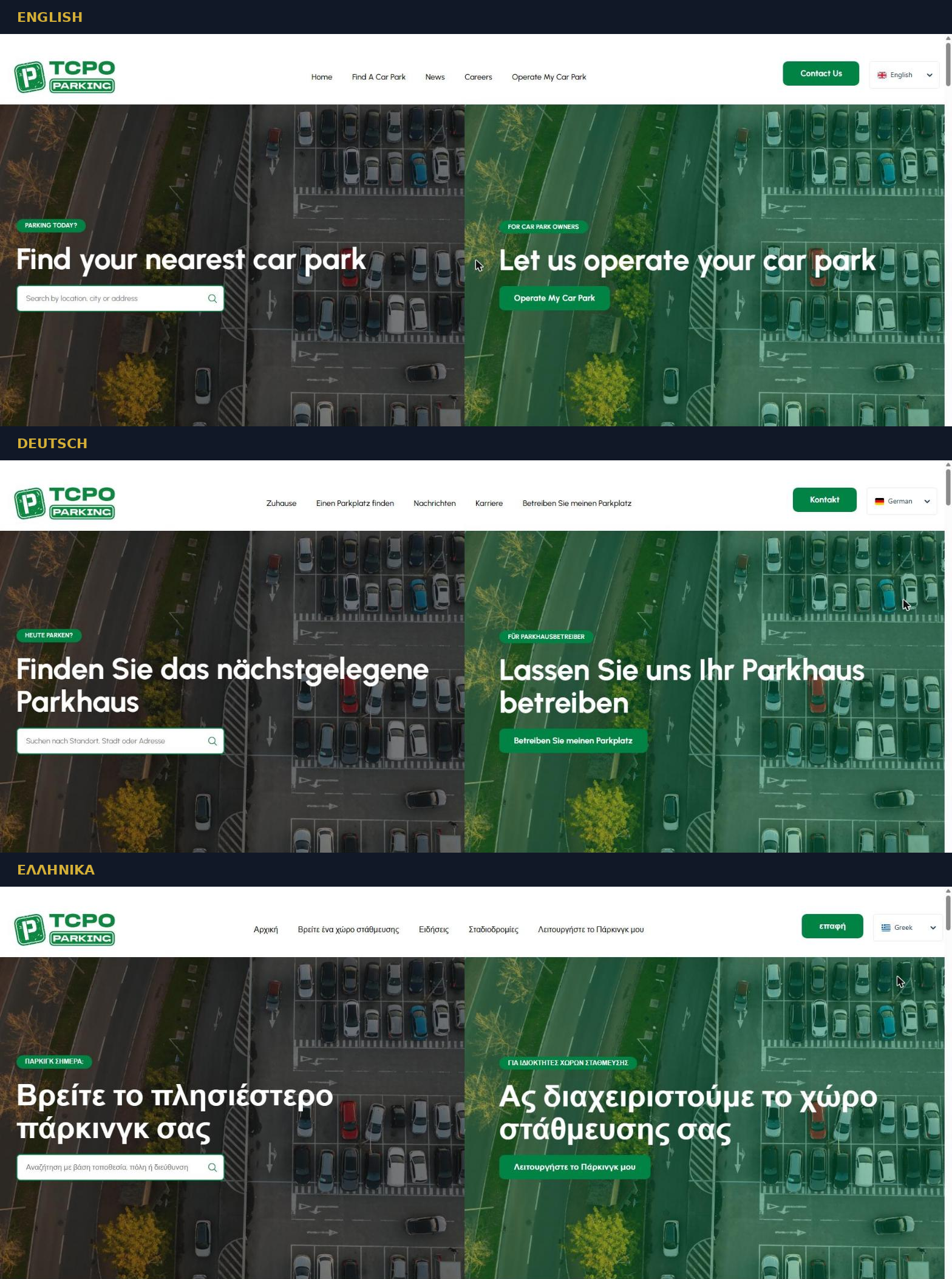
TCPO Parking operates car parks on behalf of owners across multiple European countries, competing for the attention of car park owners and investors who need to trust TCPO before they’ll hand over a site. We redesigned and rebuilt their WordPress website from the ground up, turning a stalled, confusing brief into a single, consistent site that works properly in six countries and seven languages. The site now covers the Netherlands, Belgium, Germany, France, Cyprus and Spain from one unified design system.
TCPO’s site had to do two jobs at once: convince car park owners to choose TCPO as their operator, and quietly support the motorists already using a TCPO-run car park on the ground. Partway through the build, that balance started to drift, and a project that had been signed off with a clear, narrow scope began attracting a steady stream of new requests from outside the original brief.
When the brief started drifting, we reset the project around the original scope document, agreed the distinction between new requests and already-agreed work directly with the client, and turned it into one shared, developer-ready action list.
Results
What started as a two-country, two-language build, and had since stalled under a drifting brief, is now a single consistent site live across six countries, in up to seven languages, with five working enquiry forms feeding reliably into the right inboxes.
These are delivery figures from the build itself rather than a traffic or rankings campaign, since the site has only recently gone live on its production domain. We’d expect to report on search and enquiry volume once it’s had more time to run publicly.
The site is now live on its production domain, tested and working across all six countries: every sitewide enquiry form has been verified end to end and transactional email is confirmed delivering. Next is monitoring real-world search performance and enquiry volume now the site is running publicly.
No. A well-built multilingual site runs from one codebase and one design system, with each language or region as a layer on top, which is how TCPO’s six country pages share the same header, footer and card designs instead of drifting apart from each other.
Most multilingual plugins, including the one used here, can detect a visitor’s likely language from their browser settings or their country, then offer a switch rather than forcing it, so visitors stay in control of the language they see.
It can be, if every region is built as a one-off. Built on a shared design system instead, adding or updating a region is a much smaller job, which is the approach taken for TCPO’s six country pages.
Focus Ecommerce & Marketing helps businesses operating across multiple countries build one website that works properly in every market, from multilingual design to lead-generation forms and reliable email delivery.